
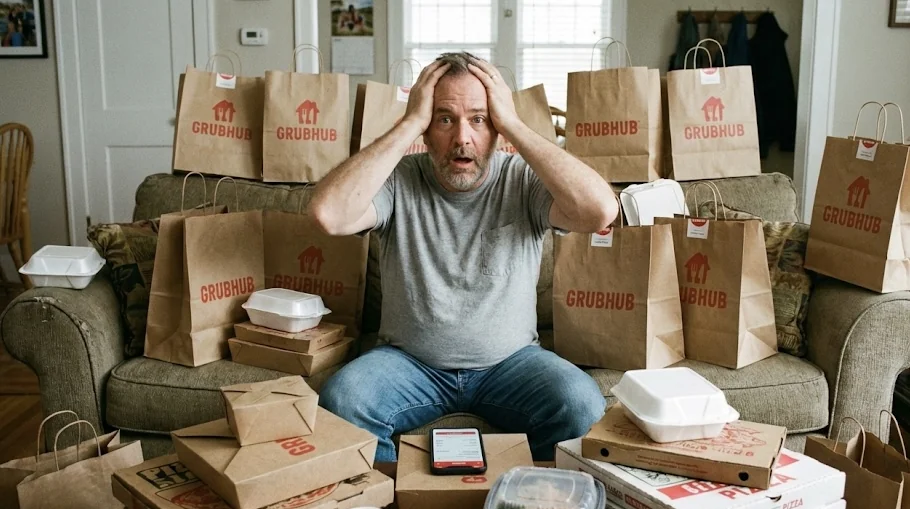
We have all been there. You're tired, it's late, and you hand your phone to your kid just to get twenty minutes of peace before bedtime. Usually, the worst-case scenario is a deleted app or a weird WhatsApp call to your boss.
But for one Michigan father, the "convenience" of the modern gig economy turned into a nightmare. As reported by The Independent, what started as screen time quickly became a very expensive lesson.
The $1,000 Shopping Spree
Keith Stonehouse let his 6-year old son, Mason, use his phone to play the usual game. What Mason actually played was "Professional Food Critic." In the span of about 30 minutes, Mason managed to quickly rack up over $1,000 in Grubhub orders.
The haul included: multiple orders of 20 jumbo shrimp, chicken sandwiches, chilli cheese fries, rice and enough Happy's pizza to feed an entire neighbourhood.
Keith Stonehouse initially thought the constant deliveries were for his wife's cake business but the doorbell didn't stop ringing. It was a parade of delivery riders dropping off bags of food that nobody asked for and nobody could possibly eat.
Any attempt to cancel the never-ending deliveries directly with the restaurants failed as the orders were already delivered, as Keith was told to get in touch with Grubhub instead.
Grubhub refund request was not accepted and Keith Stonehouse ended up having to pay for the whole order with the help of $115 from Mason's piggy bank.
The delivery app offered a $1000 gift card for future food deliveries as a gesture of goodwill, not really a great compensation for a family with months of jumbo shrimp and chilli fries in the freezer.
The "Frictionless" Trap and Why This Matters for Restaurants
From a user interface perspective, this is exactly what Grubhub, UberEats, and Deliveroo spent billions of dollars on: zero friction. Each app is designed in a way to make the ordering and reordering process as easy as possible. Saved credit card data, quick check outs and no additional verification.
There is no automated system in place to ask the question "Did the customer really mean to order $400 worth of pepperoni pizza?".
A simple check to verify the card details for orders above a certain value would have been enough to prevent Mason from going on a spending spree.
Most parents wouldn't be as "chill" as Keith Stonehouse. A $1,000 bill usually leads to frantic phone calls, refund requests on the delivery app and last resort chargebacks via a debit/credit card company. When a large, accidental order like this goes through and the customer ends up asking for a refund, the restaurant needs to watch out.
There is a risk, depending on the delivery app's policy and, sometimes, their mood of the day, that the whole or a part of that refund request will be taken from the restaurant's P&L. It is then up to the restaurant to track and dispute any unfair refund charges.
Also, the restaurant needs to keep inventory stock up to date and set an order limit per customer. Otherwise, an accidental, large order may go through with the restaurant staff scrambling to cook 30 pepperoni pizzas on a busy Friday night with not enough ingredients.
Who's to blame here is up for debate but who feels the impact of the error is clear - the restaurant. And that's one refund dispute they'd really want to win.
How to Prevent the Toddler Exploit
A $1,000 order comes in on a Friday evening - and the kitchen team on the ground is not sure if it is a genuine one. With any large, unusual orders, there is always an option to call the customer and quickly double check if the order is correct. The restaurant can then reject any accidental orders on their end.
For the delivery apps, there are certain patterns that can be implemented in the ordering system. Say a customer, who usually spends $25 once a week, suddenly orders $1,000 of food in one pop. Grubhub, Deliveroo and UberEats can identify these unusual patterns given previous order history and ask the customer to confirm card details. For Keith Stonehouse, the only thing that stopped the bleeding was a fraud alert from Chase Bank when Mason tried to drop $400 on a pizza order. By then, the damage, and the shrimp, had already arrived.